Why treat functions like data?
If you can pass around behavior, you can stop rewriting the same program over and over.
- Stake: less repetition, more reuse
- Destination: higher-order functions (args $+$ returns)
- Roadmap: pattern → abstraction → closures → composition → Newton's method
The repetition problem: three sums, one shape
def sum_naturals(n):
    total, k = 0, 1
    while k <= n:
        total += k
        k += 1
    return total
def sum_cubes(n):
total, k = 0, 1
while k <= n:
total += k ** 3
k += 1
return totaldef pi_sum(n):
total, k = 0.0, 1
while k <= n:
a = 4 * k - 3
total += 1.0 / (a * (a + 2))
k += 1
return 8 * total- Same skeleton: accumulate + step $k$
- Different: term at $k$
Functions as arguments: the summation abstraction
def summation(n, term):
    """Return term(1) + term(2) + ... + term(n)."""
    total, k = 0, 1
    while k <= n:
        total += term(k)
        k += 1
    return total
def sum_naturals(n):
return summation(n, lambda k: k)def sum_cubes(n):
return summation(n, lambda k: k ** 3)def sum_squares(n):
return summation(n, lambda k: k ** 2)- Pass behavior:
term - Sigma idea: vary $f(k)$, keep the loop
The power of $\lambda$: tiny functions, right where you need them
def square_def(x):
    return x * x
square_lambda = lambda x: x * x

def apply_twice(f, x):
    return f(f(x))

if __name__ == "__main__":
    print(square_def(5), square_lambda(5))
print(apply_twice(lambda t: t + 3, 10))- $\lambda$ = function value, not a special cheat
- Use when: short $+$ local, not reusable name
Functions as return values: factories and closures
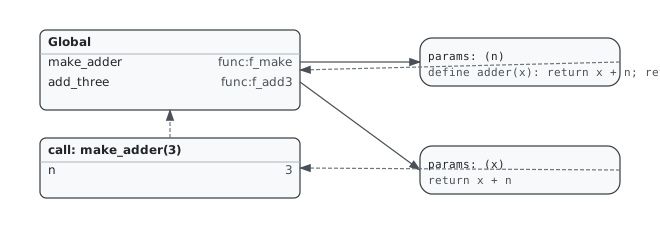
Composition: building pipelines of behavior
def compose(f, g):
    def h(x):
        return f(g(x))
    return h
def make_adder(n):
return lambda x: x + ndef square(x):
return x * xif __name__ == "__main__":
f = compose(square, make_adder(1))
print(f(5))- New function: $h(x) = f(g(x))$
- Predict:
compose(square, make_adder(1))(5)
A real application: Newton-style iterative improvement
def improve(update, close, guess, max_steps=100):
    steps = 0
    while steps < max_steps and not close(guess):
        guess = update(guess)
        steps += 1
    return guess
def newton_update(g, dg):
"""Newton's method: x - g(x)/g'(x)"""
return lambda x: x - g(x) / dg(x)if __name__ == "__main__":
# sqrt(2): solve g(y) = y**2 - 2 = 0
g = lambda y: y**2 - 2
dg = lambda y: 2 * y
close = lambda y: abs(g(y)) < 1e-10update = newton_update(g, dg)- Strategy as inputs:
update,close - Prediction: from 1.0, is the next guess above or below 1.4?
Currying: turning a two-input function into a function factory
def curry2(f):
    """Transform f(x, y) into a function that can be called as f(x)(y)."""
    return lambda x: (lambda y: f(x, y))

if __name__ == "__main__":
    curried_pow = curry2(pow)
    print(curried_pow(2)(10))

    # partial application via currying
    pow2 = curried_pow(2)
print(pow2(5), pow2(6))- From $f(x, y)$ to $f(x)(y)$
- Partial application: fix $x$, vary $y$
Exit ticket: predict, then explain why
- Practice: predict
summation(5, lambda k: 2*k) - Reflection: when return a function vs return a number?
Thank you for watching!