From mutation to objects: where does state live?
- Last time: assignment updates bindings;
nonlocalupdates enclosing bindings - Closure pattern: state captured $+$ procedures that change it
- Today: classes as a standard interface for that same bundle
- Driving question: how can one interface support many representations?
Warm-up: the closure-based bank account
def make_account(holder, balance=0):
    """Return a dispatch function representing an account."""
    def deposit(amount):
        nonlocal balance
        balance += amount
        return balance

    def withdraw(amount):
        nonlocal balance
        if amount > balance:
            return 'Insufficient funds'
        balance -= amount
        return balance

    def dispatch(message):
        if message == 'holder':
            return holder
        if message == 'balance':
            return balance
        if message == 'deposit':
            return deposit
        if message == 'withdraw':
            return withdraw
        raise ValueError('Unknown message')

    return dispatch

# Example usage
acc = make_account('Alice', 100)
print(acc('holder'))
print(acc('deposit')(25))
print(acc('withdraw')(70))
print(acc('balance'))
- State: captured variables $holder$, $balance$
- Interface: messages like
'deposit','withdraw' - Mutation:
nonlocal balanceinside methods - Key idea: message passing $=$ object-like behavior
Defining Account: __init__ and self
class Account:
    """A simple bank account."""

    def __init__(self, holder, balance=0):
        self.holder = holder
        self.balance = balance

    def deposit(self, amount):
        self.balance += amount
        return self.balance

    def withdraw(self, amount):
        if amount > self.balance:
            return 'Insufficient funds'
        self.balance -= amount
        return self.balance

# Example usage
acc = Account('Bob', 50)
print(acc.deposit(20))
print(acc.withdraw(10))
print(acc.balance)
__init__(self, ...): initialize instance attributesself: the instance being operated on- Attributes:
acc.holder,acc.balance - Methods:
acc.deposit(20)changesacc.balance
Methods are functions bound to objects
class Demo:
    def __init__(self, x):
        self.x = x

    def add_to_x(self, amount):
        self.x += amount
        return self.x
obj = Demo(10)

# Two equivalent calls:
print(obj.add_to_x(5))
print(Demo.add_to_x(obj, 5))
obj.method(arg)rewrites toClass.method(obj, arg)- Bound method:
obj.methodcarriesobjas the first argument - Names vs values:
objis a name; the instance is a value - Dispatch: which function runs depends on the class of the instance
Instance variables vs class variables
class SavingsAccount:
    interest = 0.02  # class variable

    def __init__(self, holder, balance=0):
        self.holder = holder
        self.balance = balance  # instance variable

    def yearly_yield(self):
        return self.balance * self.interest

s1 = SavingsAccount('Ana', 100)
s2 = SavingsAccount('Ben', 100)

print(s1.yearly_yield())

SavingsAccount.interest = 0.05
print(s2.yearly_yield())

s1.interest = 0.08  # shadows the class attribute for s1 only
print(s1.yearly_yield())
print(s2.yearly_yield())
- Class attribute:
SavingsAccount.interestshared default - Instance attribute:
self.balanceunique per instance - Assignment:
SavingsAccount.interest = ...affects all instances (unless shadowed) - Shadowing:
s1.interest = ...creates per-instance override
Inheritance: reuse $+$ specialize behavior
class Account:
    def __init__(self, holder, balance=0):
        self.holder = holder
        self.balance = balance
def deposit(self, amount):
self.balance += amount
return self.balancedef withdraw(self, amount):
if amount > self.balance:
return 'Insufficient funds'
self.balance -= amount
return self.balanceclass CheckingAccount(Account):
withdrawal_fee = 1CheckingAccount(Account): inherits methods and attributes- Override:
withdrawadds fee, then callssuper().withdraw(...) - New behavior with same interface: still call
ch.withdraw(amount) - Method lookup chooses the most specific implementation
How Python finds attributes: instance class parent
- Lookup rule: instance attributes first
- Then: class attributes and methods
- Then: parent classes (method resolution order)
super()= start search at the parent link
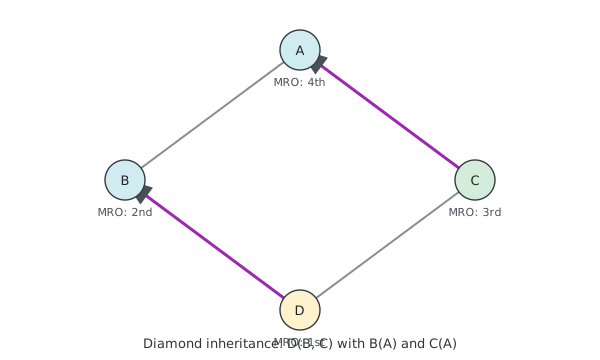
The diamond problem: multiple inheritance and MRO
SICP twist: one abstract type, many representations
import math# --- Tag machinery ---
def attach_tag(tag, contents):
return (tag, contents)def type_tag(datum):
return datum[0]def contents(datum):
return datum[1]- Why not just subclasses? New operations would require editing every representation class; tables flip that dependency
- Type tag + contents: distinguish
'rect'vs'polar' - Generic selectors:
real_part(z)works for both tags - Data-directed: add new representation by
put(...), not by editing selectors
Dispatch choices: isinstance, methods, or tables?
- Explicit type checks:
if isinstance(x, T): ...(easy, not additive) - Method dispatch:
x.add(y)(polymorphism, duck typing) - Data-directed dispatch:
apply_generic(op, x, y)(SICP 2.4/2.5) - Message passing: object receives an operation name as data
- Design goal: new types or new operations with minimal edits
Exit ticket: predict, then explain the mechanism
- Practice: what prints after
ch = CheckingAccount('Eve', 10)thench.withdrawal_fee = 5thench.withdraw(3)thenprint(ch.balance)? - Reflection: when would you prefer tables (
apply_generic) over inheritance (super())?
Thank you for watching!